TUA Freshmen Communication and Broadcasting Students Gain First-Hand Media Industry Exposure at GMA Network
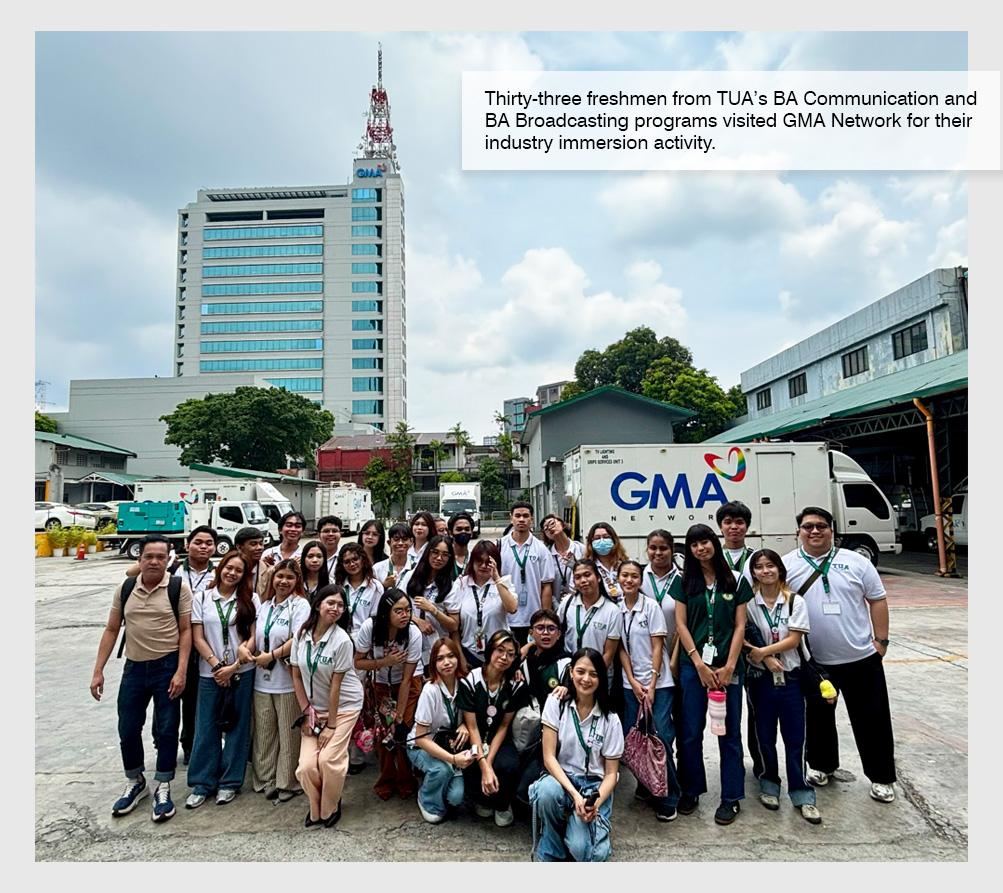 For many students, college begins inside a classroom. For 33 freshmen from Trinity University of Asia’s BA Communication and BA Broadcasting programs, it also began inside one of the country’s leading broadcast networks.
On May 19, 2026, first-year students from the Media and Communication Department visited GMA Network for the GMA Studio Tour, an industry immersion activity connected to their BR100 and COMM100 Introduction to Broadcasting and Communication courses. The students were accompanied by three faculty members, Department Head Dr. Walter Yudelmo, Media and Communication Assoc. Professor Mr. Froilan Laurente, and Asst. Dean Mr. Divino Cantal.
The activity gave students a closer look at how broadcasting works in real professional settings. More importantly, it showed them that a communication education at TUA is not limited to lectures, textbooks, and classroom discussions. At TUA, students begin to meet the industry early.
First-Year Students, First-Hand Media Exposure
For incoming college students who dream of working in media, the first year matters. It is the stage where students begin to understand what the field requires from them: discipline, clarity, creativity, confidence, technical skill, and responsibility.
The GMA Studio Tour was designed to help students become familiar with the operations of a broadcasting company, observe television production, and learn directly from media practitioners. These objectives allowed students to connect what they study in class with what they saw inside the network.
Through the visit, the freshmen had a better sense of the professional world that awaits them. They saw that media work is not just about being seen or heard. It is also about preparation, teamwork, timing, ethics, and service to audiences.
Learning from a TUA Alumna in the Media Industry
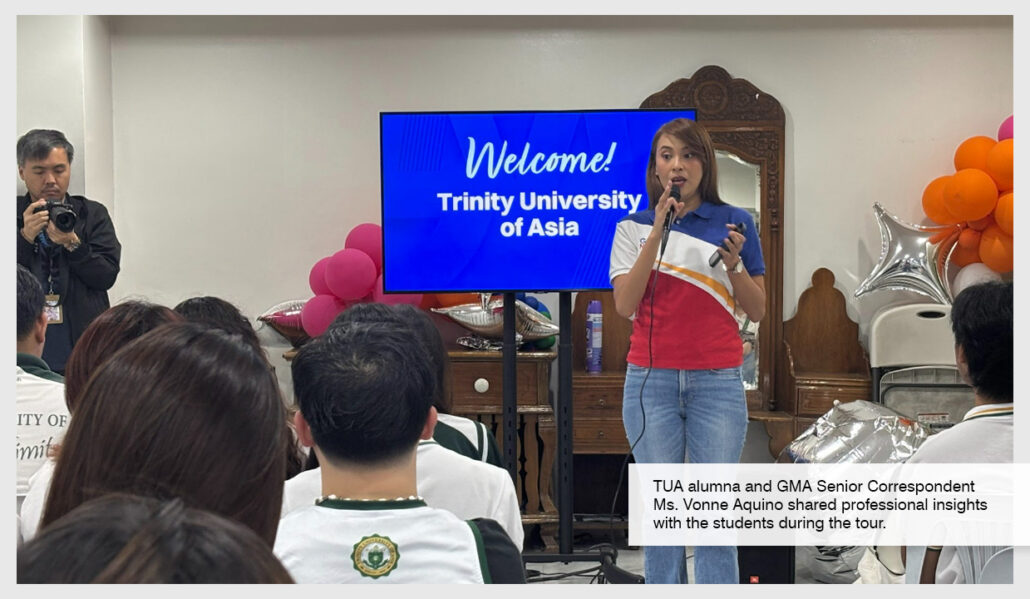
One of the highlights of the visit was the students’ interaction with Ms. Vonne Aquino, a TUA alumna and GMA Senior Correspondent.
Ms. Aquino gave a lecture to the students and shared insights from her experience in the field. The students also had the opportunity to ask questions directly, allowing them to learn from someone who once stood where they are now: a TUA student preparing for a future in media.
For prospective students, this is an important reminder. A degree in Communication or Broadcasting is not just a program on paper. It is a path that can lead to real work in major media institutions, especially when students are trained early to think, speak, write, produce, and communicate with purpose.
Inside the Newsroom and Production Studios
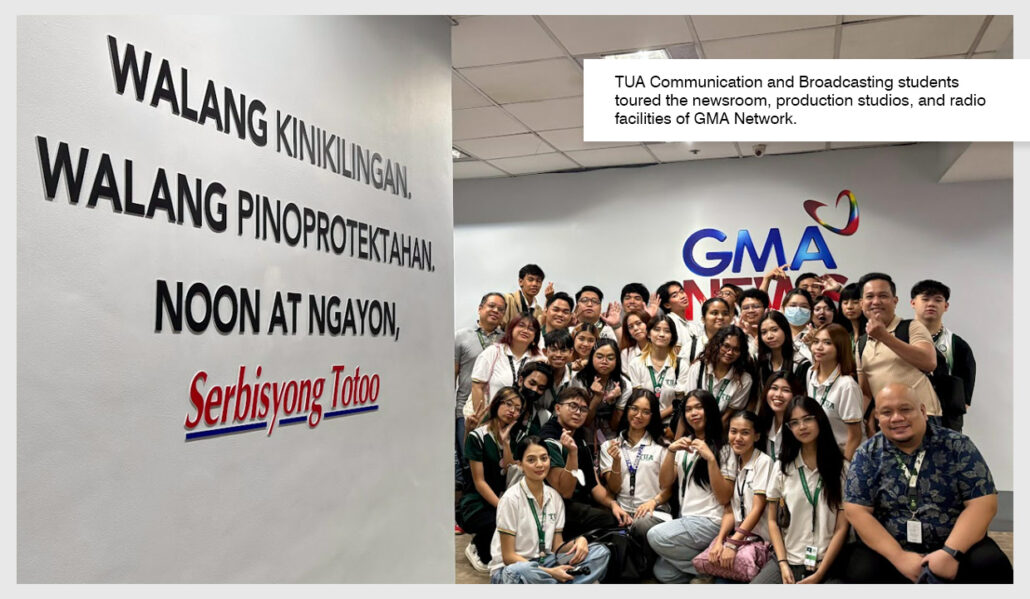
During the tour, students visited the newsroom and production studios, where they learned about the different functions of studio equipment, lights, and production spaces.
For BA Communication and BA Broadcasting students, this kind of exposure makes classroom lessons more concrete. Topics such as news production, studio work, camera language, lighting, performance, directing, and program flow become easier to understand when students see how these elements operate in an actual broadcast environment.
The students also had the chance to ask questions about how news programs are produced. This helped them understand the level of coordination required in professional broadcasting, from planning and research to execution and delivery.
From Radio Booth to On-Air Experience
The students also visited the radio facilities of Barangay LS 97.1 FM and Super Radyo DZBB 594 AM, where they interacted with disc jockeys and news anchors.
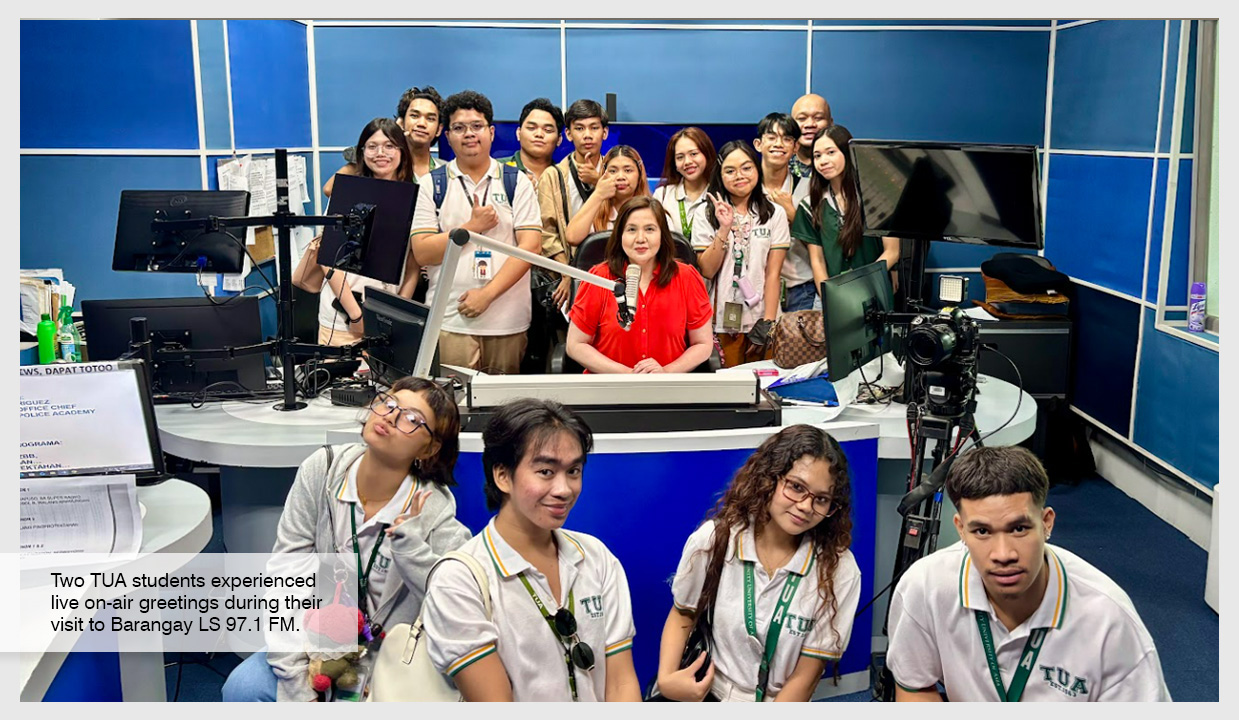
This part of the tour introduced them to the different demands of radio broadcasting. Unlike television, radio depends heavily on voice, pacing, clarity, presence, and connection with listeners. Students saw how broadcasters use sound, timing, and language to inform and engage audiences.
Two TUA students also had the chance to greet listeners and experience live broadcast on-air through the FM station. For freshmen, this was more than a memorable moment. It was an early encounter with the confidence and professionalism required in media work.
Seeing Entertainment Production Through Family Feud
Another major part of the immersion was the students’ observation of the taping of Family Feud. Through this activity, they saw how taped entertainment production is done, from studio setup to audience coordination and host interaction.
Host Dingdong Dantes also acknowledged the TUA students during the program, making the experience even more meaningful for the group.
By watching a taped show production, students gained a better appreciation of how entertainment programs are made. They saw that behind every episode are production teams, technical crews, floor directors, camera operators, writers, hosts, performers, and staff members who work together to create a seamless program for viewers.
Why Industry Immersion Matters
Media is best learned through both study and exposure. Students need theories, concepts, and classroom training, but they also need opportunities to see the industry up close.
This is why industry immersion forms an important part of the learning experience for TUA Communication and Broadcasting students. It helps them understand possible careers in television, radio, journalism, digital media, production, public relations, content creation, advertising, corporate communication, and other related fields.
It also helps them ask deeper questions about their own formation. What kind of communicator do I want to become? What stories should I help tell? How can my skills serve people better? What responsibility comes with media work?
At Trinity University of Asia, these questions are part of the education
A Strong Start for Future Media Practitioners
For incoming first-year students, choosing a Communication or Broadcasting program is also choosing the kind of formation they want to receive.
TUA’s BA Communication and BA Broadcasting programs provide students with opportunities to learn through coursework, production activities, faculty guidance, and industry exposure. The GMA Studio Tour showed freshmen that their training can begin with real encounters, real professionals, and real media environments.
They did not have to wait until the end of college to see what the industry looks like. They saw it in their first year.
For students who dream of becoming broadcasters, journalists, producers, writers, hosts, content creators, media planners, public relations practitioners, or communication professionals, TUA offers a learning environment where academic formation and industry exposure work together.
Here, students are trained to communicate with skill, think with clarity, create with purpose, and serve with care.


 The Trinitian Center for Community Development is the official arm for Community Extension Service that supports Trinity University of Asia in carrying out its Vision and Mission of involving her constituents to live a LIFE that is GOD-centered and in service to the community.